
oneaustralia

Preparing for the PTE Academic exam can feel overwhelming when you are studying without a clear plan. You may practise speaking questions one day, complete a reading exercise the next, and take a few listening tests whenever you have time. While independent practice can help, an unstructured approach often makes it difficult to understand whether you are actually improving.
A structured PTE Coaching program takes a different approach. Instead of simply giving students practice questions, it creates a step-by-step preparation journey that moves from understanding the exam format to building skills, completing targeted practice, analysing performance, taking a mock test, and finally preparing for exam day.
Whether you attend physical PTE Coaching Classes or choose Online Coaching Classes, a structured program can make preparation more organised, measurable, and focused. The goal is not simply to complete hundreds of questions. It is to understand your weaknesses, improve them systematically, and develop the confidence needed to perform under real exam conditions.
A structured PTE coaching program is an organised preparation system designed around the different stages of the PTE exam. Rather than asking students to study everything at once, coaching typically divides preparation into manageable areas.
A good program may begin with an assessment of your current English ability and then create a preparation strategy based on your target score. Students are introduced to the PTE format, question types, scoring requirements, time management techniques, and effective answering strategies.
The preparation then progresses from learning and guided practice to independent practice and simulated exams.
The overall journey can be viewed as:
Assessment → Strategy → Skill Building → Guided Practice → Independent Practice → Mock Tests → Performance Analysis → Final Revision → Exam Day
This structure helps students understand exactly what they should work on at each stage.
Before starting intensive preparation, it is important to know where you currently stand.
A structured PTE Coaching program may begin with an initial assessment or diagnostic test. This gives students and trainers an idea of their current strengths and weaknesses across speaking, writing, reading, and listening.
For example, one student may have strong reading skills but struggle with speaking fluency. Another may communicate confidently but lose marks because of grammar, pronunciation, spelling, or poor time management.
Without an initial assessment, students often spend too much time practising areas they already perform well in.
A diagnostic assessment helps answer important questions:
This first step creates a baseline against which future progress can be measured.
Once the starting point is clear, the next stage is creating a preparation strategy.
Not every PTE candidate needs the same amount of practice. A student targeting a moderate score may have different priorities from someone aiming for a high score for university admission, migration, or professional purposes.
A structured coaching program can divide preparation into short-term and long-term goals.
For example, the first few weeks may focus on understanding question types and building basic skills. The following weeks can introduce more timed practice, while the final stage can concentrate on mock exams and exam-day performance.
A preparation plan can include:
The biggest advantage of this approach is consistency. Students know what to practise rather than deciding what to study every day.
Understanding the PTE format is an important part of preparation.
The exam contains different task types, and each requires a specific approach. Students need to understand not only what the question is asking but also how their response is evaluated.
For speaking, preparation may involve tasks such as Read Aloud, Repeat Sentence, Describe Image, and Retell Lecture. Students need to develop pronunciation, oral fluency, listening ability, memory, and response organisation.
Writing preparation can focus on tasks such as Summarize Written Text and Essay Writing, where grammar, vocabulary, structure, and content development become important.
Reading requires students to work with different question formats while managing limited time. Listening requires concentration, comprehension, note-taking, and accurate responses.
A professional PTE Coaching program introduces these task types systematically rather than expecting students to learn everything through trial and error.
Learning templates or exam strategies alone is not enough for long-term improvement.
A structured preparation program also works on the English skills behind the exam.
For speaking, students may work on:
For writing, preparation can include:
Reading preparation may focus on vocabulary, comprehension, identifying key information, understanding context, and recognising relationships between ideas.
Listening practice can develop concentration, note-taking, vocabulary recognition, and the ability to identify important information quickly.
By strengthening these underlying skills, students become better prepared for different questions instead of depending entirely on memorised responses.
This is where PTE Coaching Classes can make a significant difference.
Practising alone can sometimes make it difficult to recognise why an answer is incorrect. A trainer can observe performance and identify patterns that a student may not notice independently.
For example, a student may believe that speaking problems are caused by vocabulary, while the actual issue is hesitation and unnatural pauses. Another student may know the correct writing structure but repeatedly make grammar mistakes.
During guided practice, trainers can demonstrate how to approach questions and then allow students to practise under supervision.
The cycle is simple:
Learn → Practise → Receive Feedback → Correct → Practise Again
Repeated feedback helps students turn mistakes into learning opportunities.
One of the most important elements of structured preparation is feedback.
Simply knowing your score is not enough. You need to understand why you received that score and what you should do differently next time.
A good coaching program should encourage students to maintain an error log. This can record common problems such as:
Over time, the error log can reveal patterns.
Suppose a student repeatedly makes the same type of mistake in reading. Instead of completing another 50 random questions, the trainer can focus on the specific skill causing the problem.
This makes preparation more efficient.
Coaching classes provide guidance, but students also need independent practice.
This is particularly important when choosing Online Coaching Classes, because students have access to learning from home but must also maintain a consistent routine.
A useful weekly routine could include:
Monday: Speaking practice
Tuesday: Reading and vocabulary
Wednesday: Writing practice
Thursday: Listening practice
Friday: Mixed question practice
Saturday: Timed practice or mock test
Sunday: Error analysis and revision
The exact schedule can vary according to the student's target score and available study time.
The key principle is consistency. Studying for several hours once a week is usually less useful than maintaining regular daily practice.
A mock test is one of the most valuable tools in PTE preparation because it allows students to experience the exam structure before the actual test.
However, mock tests should not be used only to obtain a score.
The real value comes from analysing the results.
After each mock test, students should ask:
A structured program can schedule mock tests at different stages of preparation.
Early mock tests can establish a baseline. Mid-preparation tests can measure improvement. Final mock tests can help students become comfortable with full exam conditions.
This creates a clear progression from practice to performance.
Taking one mock test after another without analysing the results can become counterproductive.
Imagine a student receives the following scores:
Speaking: Strong
Writing: Moderate
Reading: Weak
Listening: Strong
The next step should not simply be another complete test. Instead, the student should spend additional practice time on reading.
A trainer can identify whether the problem is vocabulary, comprehension, time management, or a particular question type.
This creates a feedback loop:
Mock Test → Performance Analysis → Targeted Practice → New Mock Test → Comparison
The purpose is to make every test more useful than the previous one.
As the exam approaches, practice should increasingly resemble the real test.
Students need to become comfortable answering questions while working against the clock.
This means practising without unnecessary interruptions and following realistic timing conditions.
For many candidates, the challenge is not simply knowing the answer. It is producing the answer accurately and quickly under pressure.
Timed practice can help develop:
This stage helps close the gap between performance during casual practice and performance under exam conditions.
The final days before the PTE exam should not necessarily involve learning everything from scratch.
Instead, students should focus on reviewing important strategies, common errors, timing, and areas that still require attention.
A structured final review may include:
The aim is to enter the examination with a clear process rather than uncertainty.
Students today have more options for preparation than ever before.
Traditional PTE Coaching Classes provide a structured learning environment where students can interact directly with trainers and other candidates. This can be useful for students who prefer classroom learning, immediate interaction, and fixed schedules.
Online Coaching Classes, on the other hand, offer greater flexibility. Students can learn from home, attend sessions remotely, and often combine live instruction with digital practice resources.
Neither format is automatically better for every student. The important factor is the quality and structure of the program.
Whether coaching is delivered in a classroom or online, students should look for:
The delivery method matters, but the learning system matters even more.
Confidence on exam day does not usually appear overnight.
It is developed through repeated exposure to the exam format.
When students have completed lessons, practised individual question types, received feedback, analysed mistakes, and completed multiple mock tests, the real exam becomes more familiar.
A structured program helps reduce uncertainty.
Instead of asking, “What should I do if I get this question?” students have already encountered similar situations during preparation.
The objective is to make the exam process feel familiar.
Students should also prepare practical details in advance, including travel arrangements, required identification, arrival time, and the location of the test centre.
Avoiding unnecessary last-minute stress allows candidates to focus on performing their best.
One of the biggest problems with unplanned preparation is inconsistency.
A student may spend two hours practising speaking but ignore writing for several days. Another may complete hundreds of reading questions without reviewing mistakes. Someone else may take a mock test every day without understanding why their score is not improving.
Structure solves this problem by giving every stage a purpose.
A structured PTE Coaching program connects learning with measurable progress.
Instead of simply asking:
“How much have I practised?”
students can ask:
“What have I improved?”
That difference is important.
Effective preparation is not measured only by the number of questions completed. It is measured by whether practice is helping you become more accurate, fluent, efficient, and confident.
Before enrolling in a program, students should look beyond promotional claims and evaluate how the preparation system actually works.
Ask whether the program provides a clear study plan. Find out whether trainers provide individual feedback. Check whether students have access to regular practice and a reliable mock test system.
It is also worth understanding whether the program tracks progress over time.
A good program should make it easy to see where you started, what you have improved, and what still requires attention.
If you prefer flexibility, ask about Online Coaching Classes and how live sessions are combined with independent practice. If you prefer face-to-face learning, explore the structure and schedule of physical PTE Coaching Classes.
The right program should match your target score, timeline, learning style, and current ability.
PTE preparation becomes easier to manage when it is treated as a process rather than a collection of random practice exercises.
From the initial assessment to skill development, guided PTE Coaching, independent practice, regular feedback, and repeated mock test sessions, every stage should have a clear purpose.
Whether you choose traditional PTE Coaching Classes or flexible Online Coaching Classes, the most important factor is having a structured system that helps you identify weaknesses, practise effectively, measure progress, and prepare for real exam conditions.
The journey from practice to exam day is not about doing the maximum number of questions. It is about making every practice session meaningful.
With the right structure, consistent effort, targeted feedback, and realistic mock-test practice, students can approach the PTE exam with a clearer strategy and greater confidence.
Preparing for the PTE Academic exam can feel overwhelming when you are studying without a clear plan. You may practise speaking questions one day, complete a reading exercise the next, and take a few listening tests whenever you have time. While independent practice can help, an unstructured approach often makes it difficult to understand whether you are actually improving.
A structured PTE Coaching program takes a different approach. Instead of simply giving students practice questions, it creates a step-by-step preparation journey that moves from understanding the exam format to building skills, completing targeted practice, analysing performance, taking a mock test, and finally preparing for exam day.
Whether you attend physical PTE Coaching Classes or choose Online Coaching Classes, a structured program can make preparation more organised, measurable, and focused. The goal is not simply to complete hundreds of questions. It is to understand your weaknesses, improve them systematically, and develop the confidence needed to perform under real exam conditions.
A structured PTE coaching program is an organised preparation system designed around the different stages of the PTE exam. Rather than asking students to study everything at once, coaching typically divides preparation into manageable areas.
A good program may begin with an assessment of your current English ability and then create a preparation strategy based on your target score. Students are introduced to the PTE format, question types, scoring requirements, time management techniques, and effective answering strategies.
The preparation then progresses from learning and guided practice to independent practice and simulated exams.
The overall journey can be viewed as:
Assessment → Strategy → Skill Building → Guided Practice → Independent Practice → Mock Tests → Performance Analysis → Final Revision → Exam Day
This structure helps students understand exactly what they should work on at each stage.
Before starting intensive preparation, it is important to know where you currently stand.
A structured PTE Coaching program may begin with an initial assessment or diagnostic test. This gives students and trainers an idea of their current strengths and weaknesses across speaking, writing, reading, and listening.
For example, one student may have strong reading skills but struggle with speaking fluency. Another may communicate confidently but lose marks because of grammar, pronunciation, spelling, or poor time management.
Without an initial assessment, students often spend too much time practising areas they already perform well in.
A diagnostic assessment helps answer important questions:
This first step creates a baseline against which future progress can be measured.
Once the starting point is clear, the next stage is creating a preparation strategy.
Not every PTE candidate needs the same amount of practice. A student targeting a moderate score may have different priorities from someone aiming for a high score for university admission, migration, or professional purposes.
A structured coaching program can divide preparation into short-term and long-term goals.
For example, the first few weeks may focus on understanding question types and building basic skills. The following weeks can introduce more timed practice, while the final stage can concentrate on mock exams and exam-day performance.
A preparation plan can include:
The biggest advantage of this approach is consistency. Students know what to practise rather than deciding what to study every day.
Understanding the PTE format is an important part of preparation.
The exam contains different task types, and each requires a specific approach. Students need to understand not only what the question is asking but also how their response is evaluated.
For speaking, preparation may involve tasks such as Read Aloud, Repeat Sentence, Describe Image, and Retell Lecture. Students need to develop pronunciation, oral fluency, listening ability, memory, and response organisation.
Writing preparation can focus on tasks such as Summarize Written Text and Essay Writing, where grammar, vocabulary, structure, and content development become important.
Reading requires students to work with different question formats while managing limited time. Listening requires concentration, comprehension, note-taking, and accurate responses.
A professional PTE Coaching program introduces these task types systematically rather than expecting students to learn everything through trial and error.
Learning templates or exam strategies alone is not enough for long-term improvement.
A structured preparation program also works on the English skills behind the exam.
For speaking, students may work on:
For writing, preparation can include:
Reading preparation may focus on vocabulary, comprehension, identifying key information, understanding context, and recognising relationships between ideas.
Listening practice can develop concentration, note-taking, vocabulary recognition, and the ability to identify important information quickly.
By strengthening these underlying skills, students become better prepared for different questions instead of depending entirely on memorised responses.
This is where PTE Coaching Classes can make a significant difference.
Practising alone can sometimes make it difficult to recognise why an answer is incorrect. A trainer can observe performance and identify patterns that a student may not notice independently.
For example, a student may believe that speaking problems are caused by vocabulary, while the actual issue is hesitation and unnatural pauses. Another student may know the correct writing structure but repeatedly make grammar mistakes.
During guided practice, trainers can demonstrate how to approach questions and then allow students to practise under supervision.
The cycle is simple:
Learn → Practise → Receive Feedback → Correct → Practise Again
Repeated feedback helps students turn mistakes into learning opportunities.
One of the most important elements of structured preparation is feedback.
Simply knowing your score is not enough. You need to understand why you received that score and what you should do differently next time.
A good coaching program should encourage students to maintain an error log. This can record common problems such as:
Over time, the error log can reveal patterns.
Suppose a student repeatedly makes the same type of mistake in reading. Instead of completing another 50 random questions, the trainer can focus on the specific skill causing the problem.
This makes preparation more efficient.
Coaching classes provide guidance, but students also need independent practice.
This is particularly important when choosing Online Coaching Classes, because students have access to learning from home but must also maintain a consistent routine.
A useful weekly routine could include:
Monday: Speaking practice
Tuesday: Reading and vocabulary
Wednesday: Writing practice
Thursday: Listening practice
Friday: Mixed question practice
Saturday: Timed practice or mock test
Sunday: Error analysis and revision
The exact schedule can vary according to the student's target score and available study time.
The key principle is consistency. Studying for several hours once a week is usually less useful than maintaining regular daily practice.
A mock test is one of the most valuable tools in PTE preparation because it allows students to experience the exam structure before the actual test.
However, mock tests should not be used only to obtain a score.
The real value comes from analysing the results.
After each mock test, students should ask:
A structured program can schedule mock tests at different stages of preparation.
Early mock tests can establish a baseline. Mid-preparation tests can measure improvement. Final mock tests can help students become comfortable with full exam conditions.
This creates a clear progression from practice to performance.
Taking one mock test after another without analysing the results can become counterproductive.
Imagine a student receives the following scores:
Speaking: Strong
Writing: Moderate
Reading: Weak
Listening: Strong
The next step should not simply be another complete test. Instead, the student should spend additional practice time on reading.
A trainer can identify whether the problem is vocabulary, comprehension, time management, or a particular question type.
This creates a feedback loop:
Mock Test → Performance Analysis → Targeted Practice → New Mock Test → Comparison
The purpose is to make every test more useful than the previous one.
As the exam approaches, practice should increasingly resemble the real test.
Students need to become comfortable answering questions while working against the clock.
This means practising without unnecessary interruptions and following realistic timing conditions.
For many candidates, the challenge is not simply knowing the answer. It is producing the answer accurately and quickly under pressure.
Timed practice can help develop:
This stage helps close the gap between performance during casual practice and performance under exam conditions.
The final days before the PTE exam should not necessarily involve learning everything from scratch.
Instead, students should focus on reviewing important strategies, common errors, timing, and areas that still require attention.
A structured final review may include:
The aim is to enter the examination with a clear process rather than uncertainty.
Students today have more options for preparation than ever before.
Traditional PTE Coaching Classes provide a structured learning environment where students can interact directly with trainers and other candidates. This can be useful for students who prefer classroom learning, immediate interaction, and fixed schedules.
Online Coaching Classes, on the other hand, offer greater flexibility. Students can learn from home, attend sessions remotely, and often combine live instruction with digital practice resources.
Neither format is automatically better for every student. The important factor is the quality and structure of the program.
Whether coaching is delivered in a classroom or online, students should look for:
The delivery method matters, but the learning system matters even more.
Confidence on exam day does not usually appear overnight.
It is developed through repeated exposure to the exam format.
When students have completed lessons, practised individual question types, received feedback, analysed mistakes, and completed multiple mock tests, the real exam becomes more familiar.
A structured program helps reduce uncertainty.
Instead of asking, “What should I do if I get this question?” students have already encountered similar situations during preparation.
The objective is to make the exam process feel familiar.
Students should also prepare practical details in advance, including travel arrangements, required identification, arrival time, and the location of the test centre.
Avoiding unnecessary last-minute stress allows candidates to focus on performing their best.
One of the biggest problems with unplanned preparation is inconsistency.
A student may spend two hours practising speaking but ignore writing for several days. Another may complete hundreds of reading questions without reviewing mistakes. Someone else may take a mock test every day without understanding why their score is not improving.
Structure solves this problem by giving every stage a purpose.
A structured PTE Coaching program connects learning with measurable progress.
Instead of simply asking:
“How much have I practised?”
students can ask:
“What have I improved?”
That difference is important.
Effective preparation is not measured only by the number of questions completed. It is measured by whether practice is helping you become more accurate, fluent, efficient, and confident.
Before enrolling in a program, students should look beyond promotional claims and evaluate how the preparation system actually works.
Ask whether the program provides a clear study plan. Find out whether trainers provide individual feedback. Check whether students have access to regular practice and a reliable mock test system.
It is also worth understanding whether the program tracks progress over time.
A good program should make it easy to see where you started, what you have improved, and what still requires attention.
If you prefer flexibility, ask about Online Coaching Classes and how live sessions are combined with independent practice. If you prefer face-to-face learning, explore the structure and schedule of physical PTE Coaching Classes.
The right program should match your target score, timeline, learning style, and current ability.
PTE preparation becomes easier to manage when it is treated as a process rather than a collection of random practice exercises.
From the initial assessment to skill development, guided PTE Coaching, independent practice, regular feedback, and repeated mock test sessions, every stage should have a clear purpose.
Whether you choose traditional PTE Coaching Classes or flexible Online Coaching Classes, the most important factor is having a structured system that helps you identify weaknesses, practise effectively, measure progress, and prepare for real exam conditions.
The journey from practice to exam day is not about doing the maximum number of questions. It is about making every practice session meaningful.
With the right structure, consistent effort, targeted feedback, and realistic mock-test practice, students can approach the PTE exam with a clearer strategy and greater confidence.
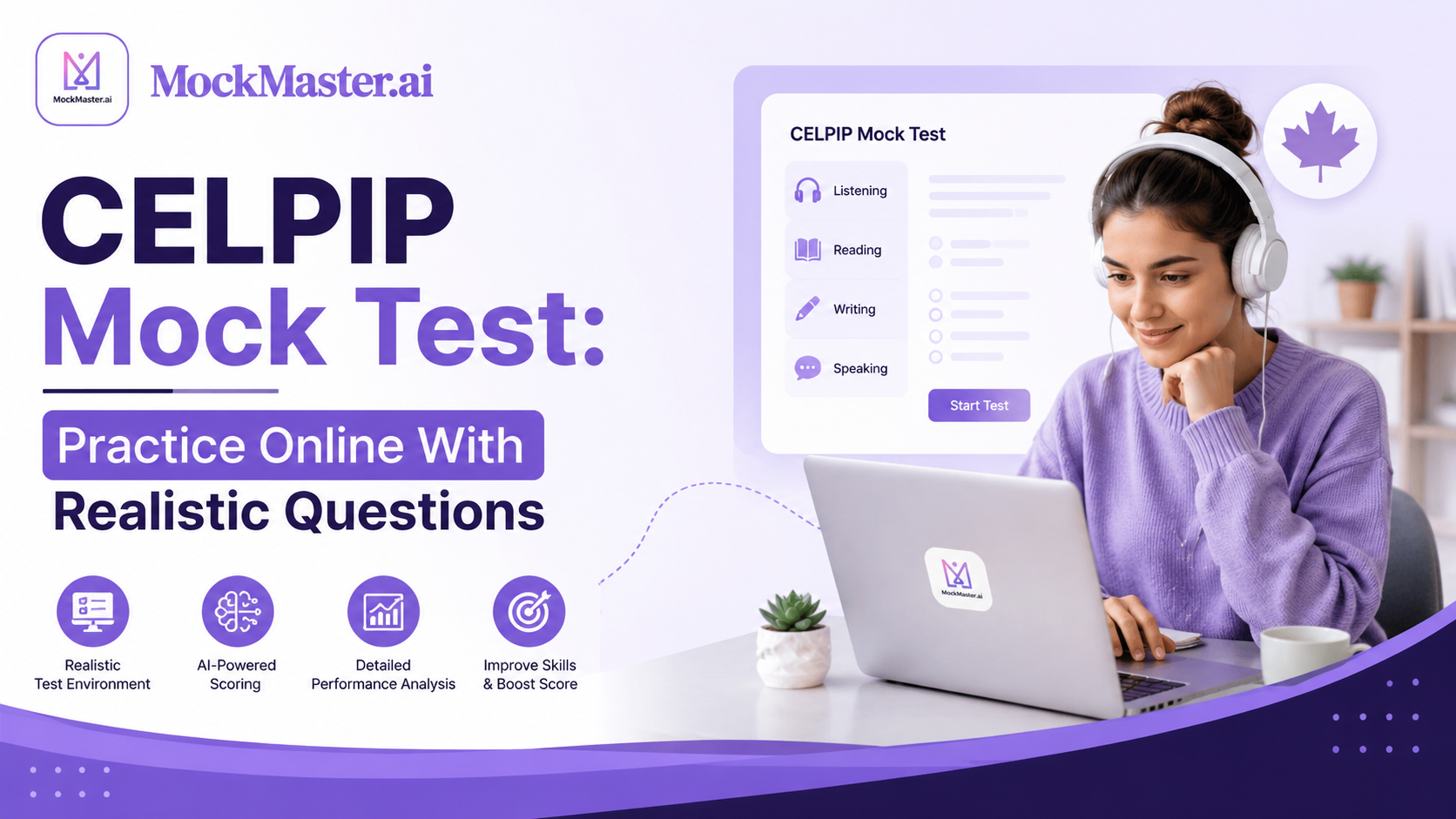

If you are preparing for the Canadian English Language Proficiency Index Program (CELPIP), you already know that this exam is different from most other English proficiency tests. It is not just about knowing grammar rules or memorizing vocabulary lists — it is about proving that you can use English the way it is actually spoken and written in everyday Canadian life. That is exactly why taking a CELPIP mock test before your real exam date is one of the smartest things you can do.
A mock test is essentially a dress rehearsal. It gives you a realistic feel for what the actual test day will be like, from the way questions are phrased to the way time pressure builds up as you move through each section. In this guide, we will walk through everything you need to know about CELPIP mock tests — what they are, why they matter, how to use them effectively, and how to find ones that closely mirror the real exam.
CELPIP stands for the Canadian English Language Proficiency Index Program. It is a Canadian-designed English test accepted for permanent residency applications through Express Entry, Canadian citizenship applications, and professional licensing in various regulated fields. Unlike some other English tests that are used internationally across many countries, CELPIP is built specifically around Canadian English and Canadian contexts, which makes it particularly relevant for anyone planning to live, work, or study in Canada.
The test comes in two versions:
The CELPIP Mock test evaluates four core skills: Listening, Reading, Writing, and Speaking. Each of these sections is scored on a scale from 1 to 12 (known as the CLB, or Canadian Language Benchmark, equivalent), and your overall band score depends on how well you perform across all four. Immigration, Refugees and Citizenship Canada (IRCC) uses these scores to assess your English proficiency for various immigration pathways, so a strong result can genuinely influence your Comprehensive Ranking System (CRS) points and, in turn, your immigration outcome.
Given how much rides on this test, it makes sense that so many candidates turn to practice materials, and among those, a full-length CELPIP mock test stands out as the most valuable tool.
CELPIP is a computer-delivered test, and its format is genuinely unique. You type your answers using a keyboard, you speak into a microphone rather than to a live examiner, and you navigate through tasks using an on-screen interface. If the first time you encounter this format is on your actual test day, you are likely to lose valuable time simply figuring out how things work. A mock test removes that uncertainty. By the time you sit for the real exam, the interface, the timers, the instructions, and the flow between tasks should feel completely familiar.
Many candidates believe their English is strong because they can hold everyday conversations comfortably or write emails at work without much trouble. However, CELPIP tests specific academic and functional skills — including your ability to summarize, compare, persuade, and respond appropriately within strict time limits. A mock test acts like a diagnostic tool. It shows you, with real numbers, where you currently stand across each of the four skills, so you are not guessing at your readiness.
Time management is one of the biggest challenges candidates face in CELPIP. The Reading section, for example, gives you a limited number of minutes per passage, and the Writing section expects you to plan, write, and revise two separate pieces within a strict window. Practicing under timed conditions, again and again, trains your brain to work efficiently under pressure rather than freezing up when the clock starts running out.
There is a psychological benefit to mock testing that is often overlooked. Walking into an exam that you have already "experienced" multiple times through realistic practice feels very different from walking in cold. Familiarity breeds confidence, and confidence often translates directly into better performance, particularly in the Speaking section, where nervousness can visibly affect fluency and coherence.
A single practice session tells you where you stand today. Taking several mock tests over weeks or months tells you a much more useful story — whether your preparation strategy is actually working. If your listening scores are steadily climbing but your writing scores remain flat, that is a clear signal about where to redirect your study time.
To get the most out of any mock test, it helps to understand exactly what each section demands.
The Listening section includes several parts: listening to a conversation, listening to a problem, listening to a daily life conversation, listening for information, listening to a discussion, viewing points, and listening to the news. You will hear each audio clip only once (except for one part, which allows a second listen), and you must answer multiple-choice questions either while listening or immediately after. This section tests not just comprehension but also your ability to follow natural, sometimes fast-paced Canadian speech patterns, including different accents and conversational fillers.
Reading is divided into four parts: reading correspondence, reading to apply a diagram, reading for information, and reading for viewpoints. The passages range from emails and informational texts to opinion-based articles. What makes this section challenging is the strict time allocation per passage combined with the need to understand tone, inference, and implied meaning — not just literal facts.
The Writing section has two tasks: writing an email and responding to survey questions with a persuasive opinion piece. You type both responses directly into the system. Graders assess content, vocabulary, readability, and task fulfillment. Many candidates underestimate this section, assuming that writing is easier than speaking, but the structured expectations around organization and register make it just as demanding.
This is often the section candidates fear most. You will respond to eight different tasks, such as giving advice, describing a scene, making a prediction, comparing and persuading, and dealing with a difficult situation — all recorded through a microphone with no live interlocutor. The lack of a real person to react to can feel unnatural at first, which is precisely why speaking-focused mock practice is so important.
Understanding this structure in advance means that when you sit down for a CELPIP mock test, you are not spending mental energy figuring out what is being asked of you — you can focus entirely on demonstrating your actual English ability.
Read More -
Not all practice materials are created equal, and this distinction matters enormously. A genuinely useful CELPIP mock test should reflect the real exam in several specific ways.
Authentic question formats. The mock test should mirror the actual task types used in the real CELPIP exam — the same style of listening scenarios, the same structure of reading passages, the same writing prompts, and the same speaking task categories.
Accurate timing. Each section should be timed exactly as it would be on test day, including the short buffer periods between tasks. Practicing without a timer, or with unrealistic time allowances, defeats much of the purpose.
Canadian context and accents. Since CELPIP is rooted in Canadian English, good mock listening materials should include Canadian accents, spellings, idioms, and everyday scenarios (banking, workplace interactions, community events, and so on) rather than generic international English content.
Computer-based delivery. Because the real test is taken on a computer, practicing by typing your writing responses and speaking into a microphone — rather than writing by hand or speaking to a friend — builds the specific mechanical skills the real test requires.
Meaningful scoring or feedback. A mock test is far more useful when it gives you some indication of your performance level, whether through an answer key with explanations, a band-score estimate, or structured feedback on your writing and speaking, rather than simply telling you whether you got a multiple-choice answer right or wrong.
Full-length format. While short quizzes on individual skills have their place, a full-length mock test — one that takes you through Listening, Reading, Writing, and Speaking in sequence — is what most closely simulates the actual test-day experience, including fatigue management across nearly three hours of sustained focus.
When evaluating any practice resource, whether free or paid, it is worth checking it against this list. The closer it matches these criteria, the more transferable your practice will be to your real result.
Simply taking a mock test is a good start, but how you engage with that practice determines how much benefit you actually get from it.
Before diving into targeted preparation, take one full-length mock test under strict, timed, no-interruption conditions. Do not look anything up, do not pause the clock, and do not skip ahead. This baseline score is your honest starting point, and it will make your progress over the following weeks much easier to measure.
It is tempting to only review the questions you got wrong, but reviewing questions you got right for the wrong reasons — a lucky guess, a misread question that happened to work out — is just as important. Understanding why an answer is correct strengthens the underlying skill rather than just fixing an isolated mistake.
Sit in a quiet room, use headphones if the real test uses them, minimize distractions, and resist the urge to pause mid-section. The more your practice environment resembles the real testing center or the at-home online proctored setup, the more reliable your practice results will be.
Since the Speaking section is delivered via microphone with no live listener, practicing by recording yourself is essential. Play back your recordings and listen critically: Are you speaking clearly? Are you pausing too long before answering? Are your ideas organized? This kind of self-review closely mirrors what an actual CELPIP rater will be evaluating.
Set a timer for each writing task and stop the moment it goes off, even if your response feels incomplete. This trains you to plan more efficiently, prioritize your strongest points early, and leave time for a quick proofread — a habit that pays off significantly on test day.
Keep a simple log of your practice test scores by section. Over two or three mock tests, you should start to see patterns: perhaps your Reading score is consistently strong while Listening lags behind, or your Writing scores plateau despite steady effort elsewhere. This data should directly shape how you allocate your remaining study time.
Rather than taking five mock tests back-to-back in a single week, spread them out with focused study in between. Take a mock test, identify weak areas, spend a week or two targeting those specific skills, then take another mock test to measure improvement. This cycle is far more effective than repetitive testing without adjustment.
Beyond mock tests themselves, build a habit of listening to Canadian media — podcasts, radio shows, or news broadcasts — to get comfortable with natural pacing and regional expressions. During practice, resist the habit of reading the answer choices before fully understanding the question, since CELPIP listening questions often hinge on subtle details rather than obvious keywords.
Practice skimming a passage for its overall structure before diving into detailed reading. Since time is tight, learn to quickly identify where in the passage a particular answer is likely to be found, rather than rereading the entire text for each question. Building a habit of reading a variety of texts — emails, opinion pieces, informational articles — outside of test prep will also build general reading stamina.
Study the structure of a strong email response (clear purpose, appropriate tone, logical organization) and a strong persuasive piece (clear stance, supporting reasons, a confident conclusion). Practice typing rather than handwriting, since typing speed and on-screen editing comfort genuinely affect how much you can produce within the time limit.
Practice speaking about unfamiliar topics on the spot, since CELPIP speaking prompts are designed to be answered without advance preparation. Work on filling your allotted response time fully rather than stopping early, and practice organizing your thoughts quickly using simple structures — such as stating your main point first, then supporting it with one or two reasons or examples.
Treating mock tests as a one-time event. A single practice test near the end of your preparation tells you very little about your growth. Regular, spaced-out mock testing throughout your study period is far more valuable than one attempt right before the real exam.
Ignoring the review process. Taking a test and moving on without carefully reviewing mistakes wastes much of the learning opportunity. The real value of a mock test often lies in the twenty or thirty minutes spent afterward analyzing what went wrong.
Practicing only the sections you enjoy. It is natural to gravitate toward practicing the skills you are already comfortable with, since it feels more rewarding. However, meaningful score improvement usually comes from deliberately practicing your weakest section, even when it is uncomfortable.
Skipping timed conditions. Practicing without a timer might feel less stressful, but it does not prepare you for the real pressure of the exam clock, which is one of the biggest factors affecting performance on test day.
Relying on a single source of practice material. Different mock tests can vary in quality and question style. Using a mix of resources, rather than repeatedly practicing with the same set of questions, gives you a broader and more reliable sense of your readiness.
There is no single correct number, since it depends on your starting level, your target score, and how much time you have before your exam. That said, a reasonable general approach looks like this:
Candidates starting from a lower proficiency level or aiming for a particularly high band score (such as CLB 9 or above for certain immigration or professional pathways) may benefit from additional practice tests, particularly focused on their weakest section.
Before you start taking mock tests, it helps to know what score you are actually aiming for. If you are applying for permanent residency through Express Entry, check the specific CLB level required for the immigration program or category you are applying under, since requirements can vary. If your goal is citizenship, confirm the minimum CLB level required for that application. If you are pursuing professional licensing in a regulated field, check with your specific regulatory body, since requirements differ by profession and province.
Once you know your target, use your mock test results to work backward. If your target is CLB 9 across all sections and your baseline mock test shows CLB 7 in Speaking, that gap tells you exactly where to concentrate your remaining preparation time, rather than spreading your effort evenly across all four skills.
A mock test is most powerful when it feeds directly into a structured study plan, rather than existing in isolation. After each mock test, consider creating a simple action plan:
This cycle — test, analyze, target, retest — is far more effective than simply working through generic study materials without a clear sense of direction.
Preparing for CELPIP is as much about strategy as it is about English proficiency. You can be a genuinely strong English speaker and still underperform on test day simply because the format, timing, and question styles caught you off guard. This is exactly the gap that a well-structured CELPIP mock test is designed to close.
By practicing online with realistic questions, timed sections, and Canadian context, you give yourself the closest possible preview of what your actual exam day will look and feel like. Combine that practice with honest self-review, a clear target score, and a study plan that responds to your actual results, and you put yourself in a strong position to walk into your real CELPIP test with confidence rather than uncertainty.
Whether you are just beginning your preparation or fine-tuning your skills before test day, make mock testing a consistent part of your routine — not a last-minute checkbox. The candidates who perform best are almost always the ones who treat practice as seriously as the real exam itself.